What is GRAIL?
GRAIL is a knowledge-graph engine that turns messy text — PDFs, markdown, notes, agent observations — into something you can ask questions of in natural language.
Unlike a search engine or a vanilla RAG, GRAIL doesn't stop at "chunks of text that look like your question". It builds a graph of who does what with whom, clusters those facts into thematic communities, and then picks between six search modes depending on the kind of question you ask.
Two ways to use the same engine
GRAIL has two write paths that produce the same artefacts. That is the framework's most distinctive trait.
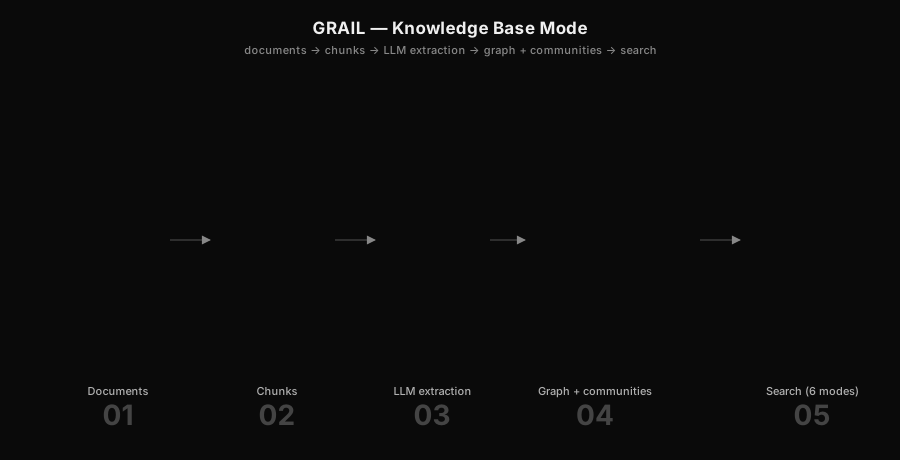
Knowledge-base mode
You have documents. You point GRAIL at the folder, run one command, and end up with a queryable graph. The LLM does the work of reading and extracting entities + relationships.
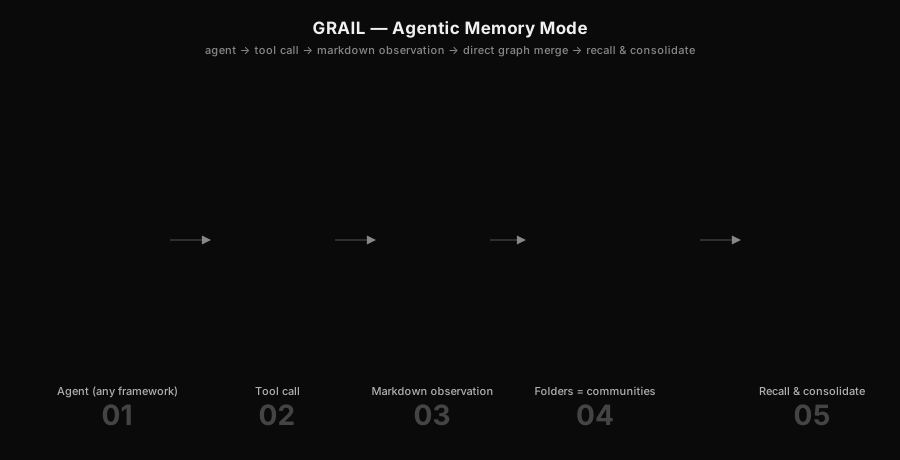
Agentic memory mode
Your agent (Claude Code, Codex, OpenCode) has things to remember across sessions. GRAIL gives it a persistent notebook: the agent writes markdown observations and declares entities and relationships directly — no intermediate LLM extraction step, because the agent already knows what it meant.
Why the graph matters
A graph is just dots connected by lines: entities are the dots, relationships are the lines. But that structure changes what questions you can answer well.
With plain text, "what drugs do this oncologist's protocols use?" forces the system to read every protocol the oncologist authored, extract drugs, and de-duplicate. With a graph, the same question is a short walk: from the oncologist's node to her protocols, from each protocol to its drugs. The answer is structural, not probabilistic.
GRAIL layers three things on top of that basic graph:
| Layer | What it does | Analogy |
|---|---|---|
| Communities | Groups related entities into clusters (Leiden algorithm) | The themed sections in the library |
| Community reports | The LLM writes a narrative summary of each community | The pamphlet for each section the librarian hands you |
| Retrieval queries | Each entity stores 2–3 anticipated questions in its embedding | The post-it the author stuck on each book: "read me if you care about X" |
Those three ingredients are the difference between a graph that just looks pretty and one that actually answers better than vanilla RAG.
When (not) to use GRAIL
GRAIL shines when:
- Your questions cross documents or cross sessions (memory).
- You need verifiable citations to real source files.
- Your corpus has concepts repeated across sources (people, laws, drugs, products, etc.).
- You want an agent to remember decisions and context across conversations.
It is not the right tool when:
- Your corpus is one short document — vanilla RAG is enough.
- You only need lexical search without synthesis — a plain BM25 is cheaper.
- You can't afford the indexing phase — GRAIL makes one LLM call per document chunk.
Next step
If you take away one idea from this page, let it be this: GRAIL combines a graph of facts with six search modes that pick the best tool for your question — and does it across your documents and your agent's memory alike.
Ready to see it in action?
- Install GRAIL and run the quickstart in 5 minutes.
- Explore the six search modes if you'd rather first understand how it picks a tool.
- See how it compares to RAG if you're coming from traditional RAG and want to know what changes.